
NY DEC Joined Cayuga Lake Hydrilla Task Force in 2022
During 2022, the NYS Department of Environmental Conservation (DEC) joined the US Army Corps of Engineers (US ACE) and Cayuga Lake Hydrilla Task Force partners to monitor and control Hydrilla (Hydrilla verticillata, an aggressive aquatic invasive species (AIS) first detected in Ithaca’s Cayuga Inlet in 2011). Since 2011, Hydrilla eradication has been the focus of the south-end Cayuga Lake Hydrilla Task Force, which includes the Cayuga Lake Watershed Network (the Network), the Finger Lakes Partnership for Regional Invasive Species Management (FL-PRISM), the City of Ithaca, Tompkins County Soil & Water Conservation District (SWCD) and others.
The Cayuga Lake Watershed Network and hardworking volunteers have provided public outreach lake-wide since 2011, with partial funding support from the Community Foundation of Tompkins County, FL-PRISM and the Tompkins Co. SWCD. Since 2012, the Network’s autumn community conferences have provided a forum for presentations about that year’s Hydrilla season around Cayuga Lake. Ten years of reports to the public can be found in the Network’s Newsletters (https://www.cayugalake.org/resources/newsletters/) and in online presentations since 2020, available on our YouTube channel (https://www.youtube.com/@cayugalakewatershednetwork/videos) Hydrilla playlist.
Localized Treatments Succeed, yet Infestation Expands Northward
To date, every reported infestation has been incorporated into the treatment plans of the south-end Hydrilla Task Force, FL-PRISM, and the US ACE, Buffalo office. As a result, the spread has been slow, and treatment has been effective in containing localized infestations. However, the threat of spread continues. The big campaigns to “Clean, Drain, Dry,” with voluntary inspections at some public launch sites by Watercraft Stewards, are only effective if boaters participate, and follow these practices at their private docks and informal launch sites. Stopping Hydrilla spread by local boat traffic, which can move fragments of the plant to new sites within the lake, remains a serious challenge.
As a result, the general trend for Hydrilla in Cayuga Lake since 2011 has been a slow but steady movement northward along the east shore of the lake. Where Hydrilla patches have been found, and treatments have been implemented, they have been successful in locally reducing the density of Hydrilla. These areas are the southern shelf of Cayuga Lake, Fall Creek, the Cayuga Inlet, marinas in King Ferry and Lansing, and Aurora. While Hydrilla density within the treated Aurora infestation is declining, in 2022 survey work found patches further to the north between Gully Road and Great Gully Creek, and south near Long Point State Park. Undoubtedly, there are more locations where it has established along the east and west shorelines beyond where it has been found to date. To confront this spread, monitoring efforts have shifted from local shoreline volunteers organized by the Network to FL-PRISM and DEC staff focused on surveying areas for new patches around marinas and high boat traffic areas.
In 2022 Hydrilla was found for the first time on the west shore of Cayuga Lake, 22 miles north of its original 2011 location. Thanks to the DEC’s Cayuga Lake Hydrilla Management Plan 2021-26 (available at www.cayugalake.org under the Resources/Hydrilla heading), the state has added new staff and ramped up their monitoring efforts. This new infestation was initially found by SCUBA divers at Sheldrake Point. Follow up surveys by the FL-PRISM and DEC verified the discovery and further delineated the infestation up to Wyers Point on the lake’s west shore. The image provided shows the sampling points as a series of dots, with Hydrilla finds represented as red dots in the water off the two points of land.

This is a heavily traveled and highly popular stretch of shoreline for boaters, property owners, and recreationists visiting wineries and restaurants. Thanks to the efforts of Hydrilla volunteers Dave and Joyce Heck and alert local residents, for many years the Network supplied Hydrilla information via indoor and outdoor boxes at numerous priority locations around the lake. It is hoped that locals remain knowledgeable about Hydrilla and will be receptive to the treatment plans that DEC and partners are developing for this area, tentatively planned to begin in 2023.
Cayuga Lake Watershed Network Continues Local Outreach, Education, and Engagement
In December 2022, the Cayuga Lake Watershed Network hosted Hydrilla management partners for presentations and panel discussion to keep the local community informed on the status of Hydrilla in our lake and management actions. To learn more about the DEC’s 2022 findings, you can watch the presentation by NYS DEC’s Region 7 Aquatic Invasive Species coordinator Mike Robinson, Dec. 1, 2022 at Network’s YouTube channel (“Hydrilla in Cayuga Lake:2022 Updates and Panel Discussion”), where you can also find presentations by the US ACE and FL-PRISM cover the east shore and southern end management efforts, as well as a presentation by the NYS Office of Parks Recreations and Historic Preservation on their watercraft inspection and education program. The Network will continue to keep the public updated about Hydrilla around Cayuga Lake.

After registering, you will receive a confirmation email containing information about joining the meeting. The recording will be uploaded to our YouTube page after the event.
Our Hydrilla Information and Action webpage is updated each year with new information as it becomes available.
Answers to questions posed by audience members
at our 12/1/2022 Hydrilla Community Conference session:
Q: Has data been collected to better understand the implications of Hydrilla control methods used on native plant and fish species in or around the affected marinas on Cayuga Lake?
A: Hydrilla grows aggressively – each stem on a Hydrilla plant can grow up to an inch per day, creating a thick mat of vegetation when it reaches the water’s surface, crowding out other aquatic plants. Hydrilla can fill water bodies up to 14 feet deep. In addition to crowding out native plants, a thick infestation reduces fish and turtle habitat, swimming, and water play. It makes paddling difficult and gets tangled in outboard motors. Watercraft get hung-up in dense stands of hydrilla to the point where docks and slips become unusable. For example, in Florida lakes, which are heavily impacted by Hydrilla growth, lanes must be mown for boat travel and swimming. As a result of these rapid, dense growth factors, a Hydrilla infestation leads to a decline in native plant diversity and abundance. This is why it is so important to catch an infestation early, when only a few plants have been detected at a site. If Hydrilla is allowed to take hold and spread, it is almost impossible to eradicate.
Of the several methods of treatment available, specialized mats have been used with some success in small areas at the south end of Cayuga Lake. Simply pulling out the plants does nothing to prevent spread, because the tubers are embedded deep in the lake bottom sediment and continue to grow and spread along the lake bottom.
More effective are targeted doses of several herbicides that are scattered in granular form within the infested areas or applied directly to the plants in liquid form. There products are Harpoon (chelated copper), Sonar H4C (fluridone pellet), and Sonar Genesis (fluridone liquid). You can read the brief and helpful Cayuga County Health Department Q&A about Fluridone (2020) and very detailed FAQ’s about Fluridone with citations on Cornell Cooperative Extension of Tompkins County’s webpage (2016). These are the well-tested products used by the US ACE to control Hydrilla in Cayuga Inlet, the mouth of Fall Creek, across the Stewart Park waterfront, the Aurora shoreline, and in several specific marinas on the lake’s east shore. Use of these herbicides in contained areas such as marinas or small coves can also be effective.
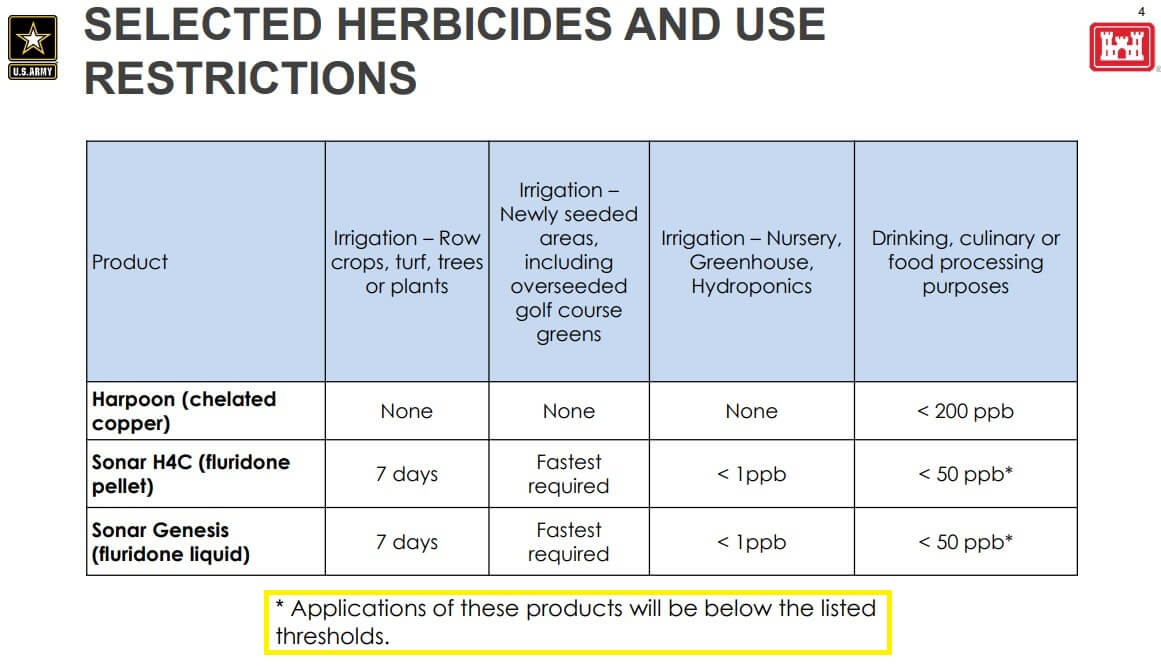
Studies of impacts of treatment on native plants in Cayuga Lake were carried out over several years by aquatic ecologist Robert Johnson and his crew. Before, during, and after each treatment season, they sampled all plant species in a grid across the southern end of Cayuga Lake and reported on plant numbers and health over time. Their conclusions were that chemical treatments of the types described above are not significantly harmful to native species. Plant surveys by the US ACE have shown some re-establishment of native plants at treatment sites once Hydrilla density is reduced. Frequently, other opportunistic invasive plants which are already well established in our lake will colonize these sites, but their ecological and recreational impact are considered far less threatening than Hydrilla.
Learn more about Hydrilla management approaches at the Tompkins County Cornell Cooperative Extension website (https://ccetompkins.org/environment/aquatic-invasives/Hydrilla/management-options).
Q: What is the 2023 Monitoring and treatment plan for the Sheldrake/Wyers Hydrilla infestation?
A: During the fall and winter of 2022-23, the NYS DEC, US ACE and FL-PRISM have met regularly to develop a monitoring and treatment plan for these sites, tentatively planned to start during the Summer 2023 season.
Liz Kreitinger, the Network’s Executive Director, is a member of the Cayuga Lake Hydrilla Task Force, the group of agencies and local stakeholders that meet regularly to plan the lake-wide Hydrilla treatment and monitoring plan. As final details emerge, with a schedule, the Network will be informing the public lake-wide via press releases and other updates. The Network is working with the community on the shoreline in the Town of Ovid to create a responsive local information sharing process. Join the Network’s email list and follow us on social media for updates!
Q: Given Hydrilla’s current distribution in Cayuga Lake, it appears we have moved from eradication to permanent management. What are the plans to minimize continued spread and respond to recurrences or new finds? What are the plans to protect the other Finger Lakes from infestation? Is anyone totaling the cost of control efforts for Cayuga Lake since treatment and monitoring started in 2011 or past/future impact of fisheries or tourism?
A: The original Ithaca-based Hydrilla Task Force and the current DEC Cayuga Lake Hydrilla Plan are focused on limiting the spread of Hydrilla and eradicating known patches. The relative cost of control/eradication and of no control, the costs to tourism, etc. were compiled by the Hydrilla Task Force for the Ithaca area during 2011-2012. A study of potential impacts and costs of Hydrilla infestation and treatment to local south-end Cayuga Lake tourism, fishing, swimming, etc., and a study of annual financial benefits to the Finger Lakes of clean water for recreational uses were conducted. Annual information is also available on the costs of attempting and failing to manage Hydrilla in other states. These reports and data are available in the Hydrilla archives held at the Tompkins County Cooperative Extension website. The appearance of Hydrilla in Cayuga Lake, along with increasing study and control of Aquatic Invasive Species via the establishment of the FL-PRISM (Finger Lakes Partnership for Regional Invasive Species Management, housed at the Finger Lakes Institute), led to demands for more effective control laws by the Finger Lakes Regional Watershed Alliance and other community groups. Did you know that you can be fined for transporting Hydrilla on your boat or trailer? (https://www.dec.ny.gov/animals/99141.html) . Additionally, all the Finger Lakes now have annual voluntary boat inspections at their major launches, carried out by trained Watercraft Stewards who also provide information about Hydrilla and other Aquatic Invasive Species.
More funding for public outreach would be a big boost in keeping Hydrilla under control around Cayuga Lake. The Network is very grateful for partial financial support from the Tompkins County Soil and Water Conservation District office, but the actual cost in staff time has been much higher. Long-term funding support for the local, lake based Hydrilla public outreach we have provided since 2011 is critical to continuing this work.
Q: Research indicates that treatment should continue several years after the last Hydrilla plant is found – to kill all the tubers. What are the plans for these treatment areas as plants stop being found?
A: The process of scientifically determining treatment and monitoring timelines is conducted using data and consensus-driven decision-making. Given that tubers can remain viable 7-10 years, the USACE, DEC, and FL PRISM return to designated locations for repeated measures over time to evaluate the effectiveness of treatment on the hydrilla tuber bank. Density of tubers in each sediment core sampled is used to assess long-term effectiveness of herbicide treatment, including after treatment ends at a site. A monitoring plan will be put in place after the last planned treatment. Reports and assessments of these issues and the related decisions to reduce or expand treatment and monitoring 2011-present on record in the Task Force archives for the Hydrilla-impacted areas in Cayuga Inlet, Fall Creek, and along the Stewart Park shoreline.
Q: The Hydrilla at the private boat launches on Cayuga Lake went unreported for years. One marina owner was aware of the Hydrilla treatment efforts on the Inlet and still didn’t report the plant. Has the State thought about other approaches, especially for marinas?
A: More precisely, three marinas along the lake’s southeast shore that were regularly provided with Hydrilla information, brochures, and signs, by the Network’s volunteer team ended up with major Hydrilla infestations.
The revelation that the Hydrilla information was being ignored led to a sense of despair and failure by our original Hydrilla outreach hero, Dave Heck. For Network staff, we took a hard-eyed look at our 75 information sites around the lake, which were being checked regularly and restocked by a mixture of Network and FL-PRISM staff and volunteers. We decided that the effort and costs were not yielding good results in terms of Hydrilla being found early. At present, Hydrilla brochures and signs will only be available at launches and businesses on the shoreline adjacent to treatment areas.
Thank you to Lynne Leopold, Tom Casella, John Abel, Bill Abel, Jenn Tufano, Michelle Henry, Paul Closs, Dave and Joyce Heck, the Village of Aurora, the Cayuga Lake Hydrilla Task Force and to the many others who have given your time for this effort!
Written by Hilary Lambert, past CLWN Executive Director, and Liz Kreitinger, CLWN Executive Director.