In response to the new threat of HABs in our lake, in 2018, the Community Science Institute (CSI), the Cayuga Lake Watershed Network (the Network), and Discover Cayuga Lake (DCL) responded quickly to the need for coordinated communications and community science. As a result, our lake has one of the most comprehensive HABs monitoring and testing programs in the state.
The goal is to collect actionable data on HABs; disseminate those results in near real-time to inform the public of potential health risks from HABs on the Cayuga Lake shoreline; and communicate seasonal and spatial patterns of bloom occurrence, composition, and toxicity.
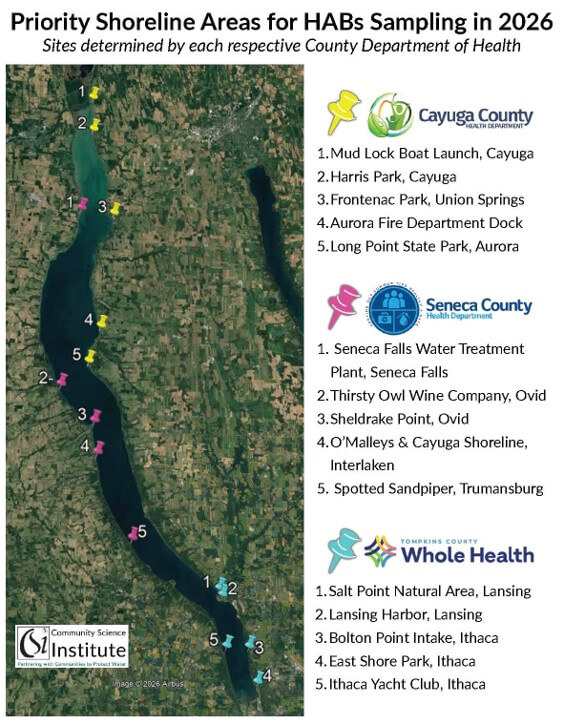
The program led by the Community Science Institute’s Cayuga Lake HAB Monitoring Program Coordinator who organizes dedicated HABs Harrier volunteers trained to monitor Cayuga Lake’s shoreline weekly as well as collect and transport suspicious blooms to their laboratory in Ithaca for analysis. Since 2025, HABs Harriers collect samples from priority sites which have been identified by county health departments around our lake, instead of every bloom. At the lab, samples are tested for the presence of cyanobacteria, the concentration of total chlorophyll a, bloom biomass, and the concentration of microcystin toxin. CSI also manages the HABs Hotline (habshotline@gmail.com) to respond to HABs reports, questions, and concerns. Learn more about the Cayuga Lake HABs Monitoring Program at the Community Science Institute’s website.
The Cayuga Lake Watershed Network leads public communications including these weekly newsletters (also posted to our website), social media updates (Facebook, Instagram), annual Community Conference sessions on the latest HABs season, press releases, and more. Cayuga Lake Watershed Network recruits our members and the broader community to volunteer throughout the year.
Discover Cayuga Lake uses its boat the M.V. Teal to watch for blooms in the lake and provide educational programs, including their Lake Monitoring Cruises.